
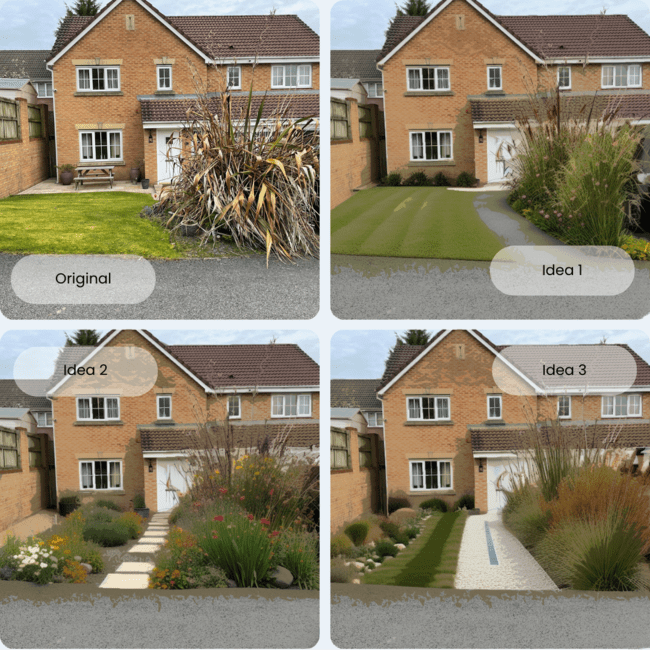
Over the years, I’ve noticed that one of the biggest sources of misunderstanding in garden design projects isn’t budgets, planting, or even builders.
It’s revisions.
At first glance, revisions sound simple enough. You receive a design, you make a few comments, the designer updates the drawings, and everyone moves on.
But in reality, a revision round is often one of the most important stages of the entire design process.
I’ve written this article because I think it’s helpful for clients to understand what a revision round really means, what it is intended to achieve, and perhaps more importantly, what it isn’t.
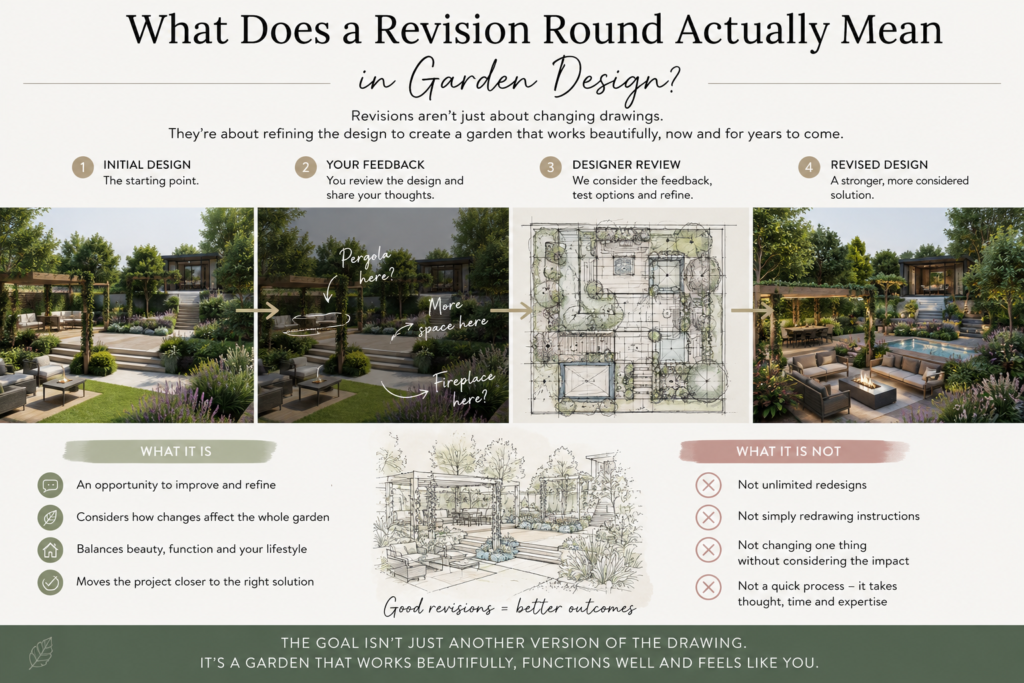
A Revision Round Is About Improving the Design
A revision round exists to help refine a proposal once you’ve had time to sit with it.
No matter how detailed the briefing process is, there are always things that only become apparent once you can see your garden laid out in front of you. You might realise a dining space feels too large, that you’d prefer the pergola in a different location, or that a feature you initially loved no longer feels quite right.
Equally, new information sometimes appears midway through a project.
Perhaps you’ve spoken to a builder who has raised a construction issue. Maybe you’ve visited a friend’s garden and discovered a material you now prefer. Sometimes life changes, budgets shift, or family priorities evolve.
This is exactly what revisions are for.
They provide an opportunity to revisit the design together and move it closer to what feels right.
Gardens Are Systems, Not Collections of Objects
One of the biggest misconceptions about revisions is that they are simply a case of changing a drawing.
Unfortunately, gardens don’t work like that.
Gardens behave much more like systems than collections of independent features.
Move a pergola and you may affect how people circulate through the garden.
Increase the size of a patio and you may lose opportunities for planting.
Add a firepit and suddenly seating arrangements, sightlines, lighting and storage all need reconsidering.
Change levels and you may need to rethink retaining walls, steps, drainage and accessibility.
In many cases, a seemingly small request can trigger a chain reaction throughout the entire design.
This means a revision round isn’t simply redrawing what has been requested. It involves revisiting the original objectives, questioning whether the changes still support them, testing alternatives, and making sure the garden still feels balanced and cohesive as a whole.
What a Revision Round Is Not
A revision round is not unlimited redesign.
It isn’t a process of producing endless versions until every possible idea has been explored.
Nor is it a drafting exercise where instructions are mechanically translated into drawings without consideration.
As designers, our role is to challenge ideas when necessary, suggest alternatives, and sometimes explain why a proposed change may solve one problem while unintentionally creating another.
The aim isn’t to say yes to everything.
The aim is to arrive at the best possible garden.
The Goal Is Progress, Not Perfection
Every successful project I’ve worked on has had moments where the path forward felt unclear.
Clients change their minds.
Designers discover better solutions.
Builders contribute practical insights.
Budgets evolve.
The process can feel messy in the middle.
But that’s okay.
Because the middle of a project is where the thinking happens.
A good revision round should leave everyone feeling more confident about the direction of travel, even if it means taking a step back before moving forwards again.
Ultimately, the goal of a revision round is not simply to produce another version of a drawing.
It is to ensure that each iteration moves the project closer to a garden that works beautifully, functions well, reflects how you truly want to live, and remains faithful to the aspirations discussed at the very beginning.
And that is why revisions matter so much.
They’re not just edits.
They’re part of the design.